


1. Classified by structure and alloy type
Industrial pure titanium tubes: TA1 and TA2 grades, focusing on corrosion resistance and processability, used in chemical heat exchangers and electroplated anodes;
Titanium alloy tube:
α+β alloy tube: such as TC4, with excellent comprehensive performance, suitable for aerospace structural components;
Corrosion resistant alloy tube: such as TA10, resistant to crevice corrosion, used in seawater desalination equipment.
2. Classify by processing form
Seamless titanium tube: formed by extrusion, oblique rolling or cold drawing, with uniform wall thickness, suitable for high-pressure scenarios;
Welded titanium tube: made of rolled plate welding, low cost, used for low-pressure transportation.
Domestic brand: TA2 TC4、 TA9, Gr23.
International grades: Gr2, Gr5, Gr7, etc.
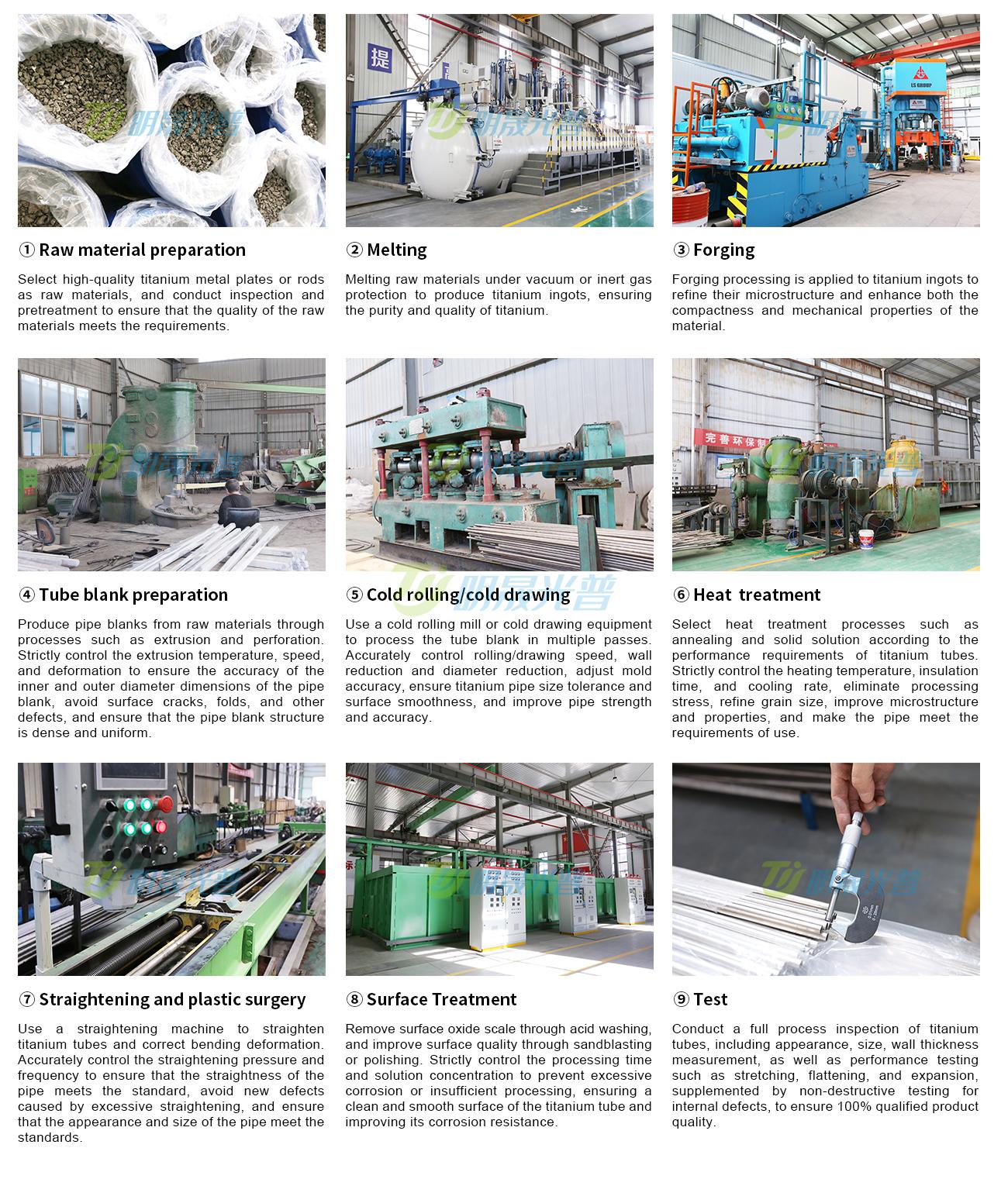
1. Melting: Vacuum consumable arc furnace or electron beam melting is used to ensure uniform composition and impurity content<0.1%;
2. Molding process:
Extrusion molding: heated to 800-950 ℃, extruded through a mold to form a blank tube;
Cold rolling/cold drawing: precision machining to target size at room temperature, surface roughness Ra ≤ 0.4 μ m;
3. Welding treatment: argon arc welding or laser welding, with a weld strength of over 90% of the base metal;
4. Surface treatment: acid washing, sandblasting or anodizing to enhance corrosion resistance and aesthetics.
High strength and lightweight: TC4 titanium tube has a tensile strength of 895-1100MPa and a density of only 60% of steel;
Corrosion resistance: It has better corrosion resistance to seawater and chlor alkali media than stainless steel, and its service life is increased by 3-5 times;
Temperature adaptability: TA7 titanium tubes maintain toughness at -253 ℃, while TC11 alloy tubes can be used for long-term high temperatures up to 600 ℃;
Biocompatibility: Non toxic, non-magnetic, in compliance with ISO 5832 standard.
Aerospace, chemical and marine industries, energy industry, military equipment.

