


1. Classified by material and alloy type
Industrial pure titanium coil: represented by TA1 and TA2, with a thickness of 0.01-8.0mm, focusing on corrosion resistance, suitable for chemical and marine engineering;
Titanium alloy coil:
α+β type alloy: such as TC4, with a strength of ≥ 895MPa, used for aerospace structural components;
Corrosion resistant alloys, such as TA10, are resistant to crevice corrosion and suitable for acidic environments.
2. Classify by processing form
Precision titanium foil strip: thickness 0.01-0.3mm, surface roughness Ra ≤ 0.2 μ m, used for 3C electronics and flexible sensors;
Conventional titanium coil: thickness 0.3-6.0mm, cold-rolled or hot-rolled, suitable for bipolar plates of new energy batteries and chemical fillers.
3. Classify by surface condition
Cold rolled glossy surface: high reflectivity, suitable for decorative scenes;
Annealing oxidation surface: a dense oxide film on the surface to enhance corrosion resistance, used in chemical equipment.
Domestic grades: TA1, TC4, TA9.
International grades: Gr1, Gr5, Gr7.
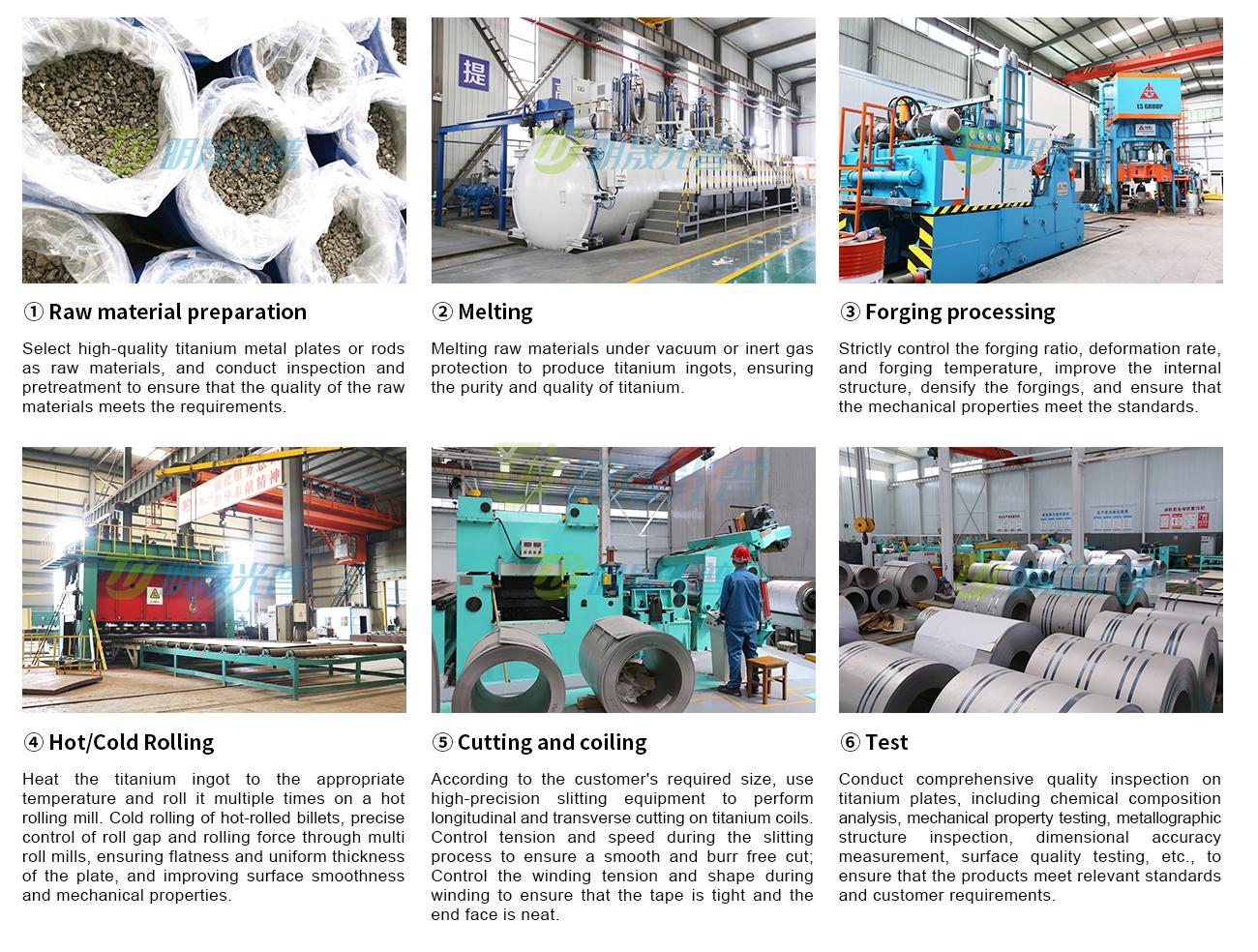
1. Melting and Casting:
Electron beam cold bed furnace melting, impurity content<0.1%, forming 190mm × 1280mm flat ingots;
2. Hot rolling forming:
Hot rolling at a temperature of 800-950 ℃ to optimize material uniformity;
3. Cold rolling precision machining:
Cold rolling with a 20 roll precision rolling mill to 0.01-1.0mm, with a surface roughness Ra ≤ 0.2 μ m;
4. Annealing treatment:
Vacuum or inert gas protected annealing to eliminate work hardening;
Surface treatment:
Acid washing, anodizing or coating processes enhance corrosion resistance and functionality.
1. Lightweight and High Strength: Density of 4.5g/cm ³, TC4 tape tensile strength of 895-1100MPa;
2. Corrosion resistance: The surface TiO ₂ oxide film is resistant to seawater, acidic and alkaline media, with an annual corrosion rate of less than 0.01mm;
3. Biocompatibility: Compliant with ISO 5832 standard, suitable for orthopedic implants and dental implants;
4. High temperature stability: TA15 coil has a strength of ≥ 450MPa at 600 ℃ and is suitable for aviation engine components.
Aerospace: aircraft fuselage skin, engine blading;
Chemical new energy: electrolysis cell bipolar plate, hydrogen fuel cell guide plate;
3C Electronics: smartphone frame, flexible circuit substrate;
Ocean engineering: seawater desalination filters, ship heat exchangers.

